Policy changes, litigation, and new investment products are making alternative assets more accessible in retirement plans, particularly through target date funds. Kevin Grogan, Focus’ CIO, Systematic Strategies, explores how private investments are valued and whether that valuation accurately reflects their risk.
Over the past couple of years, we’ve seen an evolution of policy, litigation, and product development all related to private investments in 401(k) plans. The most useful thing for plan participants to understand is how these investments are valued, since holdings priced by periodic estimate can report steadier returns than their underlying risk would suggest.
This article examines how private equity, private credit, and private real estate are valued compared with publicly traded investments, and why periodic valuations can make private assets appear less volatile than they really are. It also explores the evolving regulatory landscape, the potential benefits and drawbacks of adding alternatives to 401(k) plans, and what investors should consider when determining what they actually own.
Key Takeaways
- Private investments are becoming more accessible in 401(k) plans, particularly through target date funds, although adoption remains limited today.
- Valuation matters: Because private assets are valued periodically rather than through daily market prices, their reported returns can appear smoother and less volatile than their underlying risks suggest.
- The benefits come with trade-offs: Private investments may offer diversification and potentially higher returns, but they can also involve higher fees, complexity, and less transparent pricing.
- Know what you own: Investors should check whether their target date fund includes private investments, how much is allocated to them, how those assets are valued, and what they cost.
Evolution of Policy and Litigation
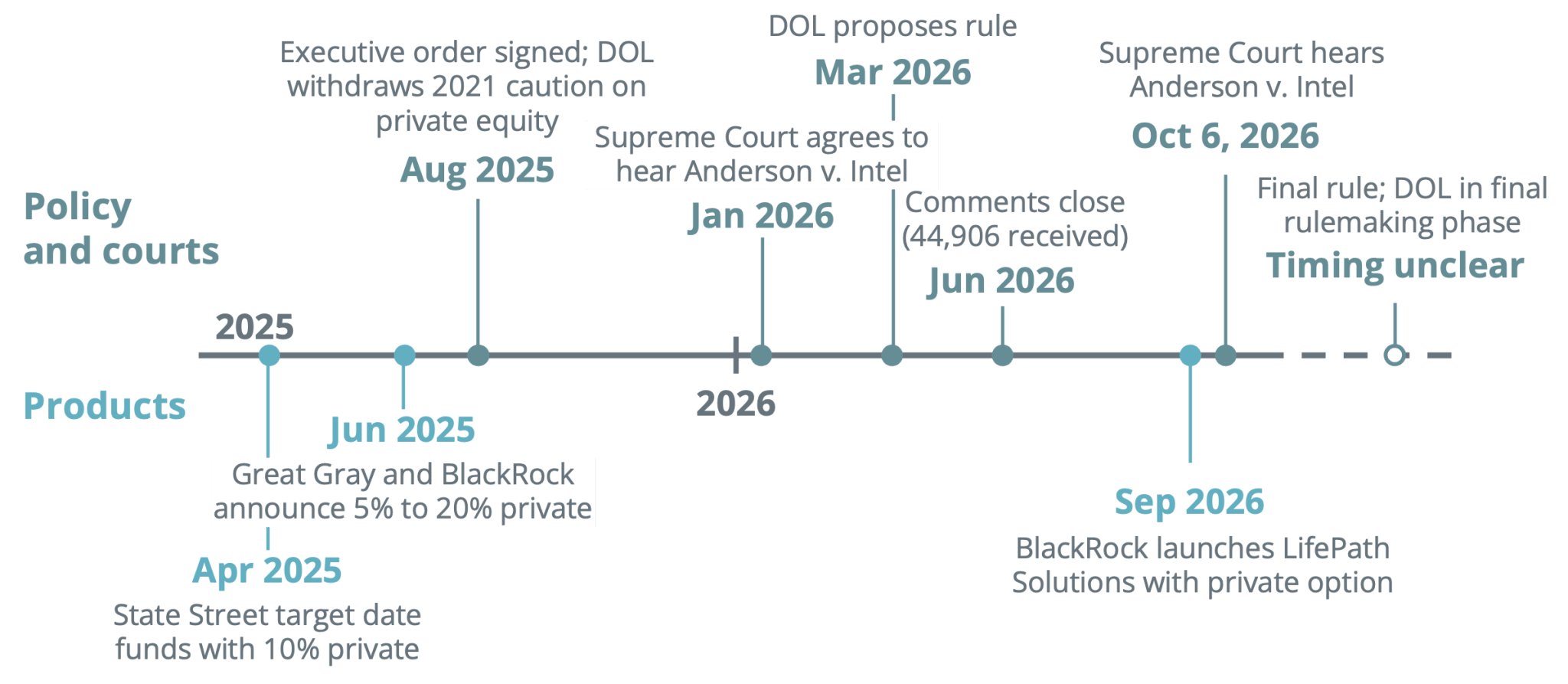
On August 7, 2025, President Trump signed “Executive Order 14330 “Democratizing Access to Alternative Assets for 401(k) Investors,” which directed the Department of Labor (DOL), the Securities and Exchange Commission (SEC), and the Treasury to make it easier for retirement plan sponsors to add alternative assets to their plan lineups. Shortly after the executive order, the DOL rescinded its 2021 statement that warned plan sponsors against including private equity as a component of other funds. On March 30, 2026, the DOL proposed a rule to provide guidelines that 401(k) sponsors can follow when including alternative assets in their plan lineups. This rule is not final at this point, although it has entered the final rulemaking phase. It is unclear how long this phase will last, as the DOL has 44,906 comments to work through on this rule.
The Supreme Court heard arguments on Anderson v. Intel on October 6, 2026. This case focuses on Intel’s use of custom target date funds designed to reduce risk by including a meaningful allocation to alternative assets like private equity and hedge funds. The plaintiffs allege that Intel’s investment decisions led to underperformance and higher fees relative to the more common target date fund portfolio construction that includes higher allocations to public equities. The question before the Court is whether when a participant says an investment’s underperformance suggests Intel’s investment policy committee acted imprudently, does the complaint have to identify a genuinely comparable investment to get past a motion to dismiss? Intel’s brief argues that the Court should weigh how to prevent hindsight bias in comparisons from replacing evidence of a flawed decision. The federal government filed in Intel’s support. The plaintiffs argue the benchmark requirement is judge-made and has no basis in the law. Importantly, the Court is not deciding whether Intel’s use of private equity and hedge funds was prudent.
Product Development Among Asset Managers
We have seen large asset managers like State Street and BlackRock begin to offer target date strategies that include private investment options. A Schroders survey found that 45% of 401(k), 403(b), and 457(b) retirement account participants would invest in private assets if they were available in their plan. That said, adoption of alternatives in 401(k) plans is still relatively small today.
Private investments would reach most savers via a default target date fund chosen by plan fiduciaries, not a separate menu option. Vanguard’s How America Saves 2026 provides statistics on more than 1,300 retirement plans and nearly five million participants for which Vanguard directly provides recordkeeping services. That study found:
- 98% of plans use a target date fund for the default investment option.
- 84% of plan participants use target date funds.
- 64% of plan contributions are invested in target date funds.
If private investments make their way into target date funds, many participants will hold private assets without making an intentional investment.
Concerns About Valuation
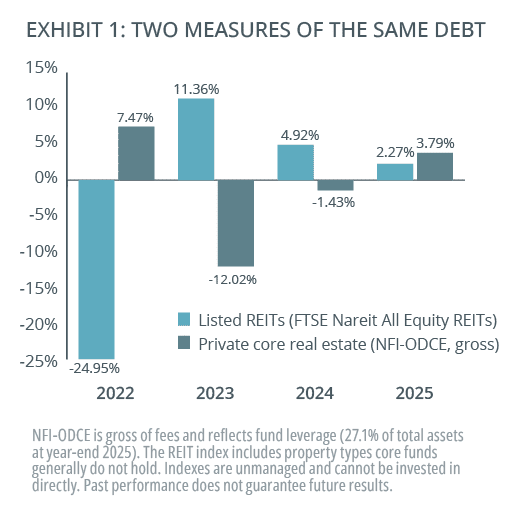
Private holdings are valued periodically using models, comparable transactions, and appraisals rather than daily trades. This has the effect of reducing the stated volatility of private asset classes. Private asset managers generally attempt to provide their best estimate of the value of their holdings, but because there is no public market for the assets, there is no daily price discovery that provides a “wisdom of crowds” check on the value managers put on their investments.
Private Credit
A recent study took advantage of the Business Development Company (BDC) structure to evaluate whether private credit funds were valued fairly. BDCs hold portfolios of private credit loans and report Net Asset Value (NAV) quarterly, while the BDCs themselves are publicly traded with prices that change every day. This study found that during periods of credit stress, market prices reacted faster than NAVs. However, it did not find that market prices are always right nor that the NAVs are always stale. There are times when quarterly NAV updates cause the stock prices to change in reaction to the news.
Private Real Estate
The year 2022 was a very challenging one for public markets. Both stocks and bonds were down as the Fed began raising interest rates to combat inflation. As shown in Exhibit 1, publicly traded real estate was also down sharply in 2022, while private real estate’s decline arrived a year later. Over the full 2022–2025 period, private real estate returned –3.3% vs. –10.3% for listed REITs.
Private Equity
Exhibit 2 shows this same effect for private equity, with more muted negative returns for private assets versus public assets.

Reported volatility statistics, like standard deviation, tend to be understated for private assets due to this smoothing in the valuations. The understatement is large for private equity and real estate, and generally smaller for private credit. Inside a target date fund, the private sleeve is likely 20% or less, so the effect on the whole fund’s reported volatility is modest.
The Case on Each Side
Supporters claim that private investments have only been available to the very wealthy, and that these assets can increase the expected return and/or provided further diversification to the portfolios of retirement plan participants. Cliffwater found that private equity outperformed public equity by 3.7% per year for the 25 years ending June 30, 2025. Critics point to the higher fees and greater complexity of private investments. The Economic Policy Institute, a public policy think tank focused on issues affecting low and middle-income workers, came out against the executive order, saying “the rule would add complexity, raise fees, and return us to an era when retirement plan participants had little protection from poor investment choices.”
Lessons for Investors
The biggest takeaway for investors is to make sure you know what you own. If you are invested in a target date fund through your 401(k), investigate whether it holds private investments. If it does, understand what percentage of the fund is allocated to private investments, how those investments are valued, and what that sleeve costs. An advisor can also evaluate your retirement plan investment options and help you understand which options fit best with your financial plan and the assets you hold outside your 401(k) plan.
The information provided is educational and general in nature and is not intended to be, nor should it be construed as, specific investment, tax, or legal advice. Individuals should seek advice from their wealth advisor or other advisors before undertaking actions in response to the matters discussed. No client or prospective should assume the above information serves as the receipt of, or substitute for, personalized individual advice. This reflects the opinions of Focus or its representatives, may contain forward-looking statements, and presents information that may change. Nothing contained in this communication may be relied upon as a guarantee, promise, assurance, or representation as to the future. Past performance does not guarantee future results. Market conditions can vary widely over time, and certain market and economic events having a positive impact on performance may not repeat themselves. The charts and accompanying analysis are provided for illustrative purposes only. Investing involves risk, including, but not limited to, loss of principal. Focus’ opinions may change over time due to market conditions and other factors. Numerous representatives of Focus may provide investment philosophies, strategies, or market opinions that vary. The appropriateness of a particular investment or strategy will depend on an investor’s individual circumstances and objectives. Investments described may not be suitable for all clients. Individuals should speak with a qualified professional to review the risk characteristics of alternative investments and determine their appropriateness based on each individual’s circumstance. Any index or benchmark shown or discussed is for comparative purposes to establish market conditions. Index returns are unmanaged and do not reflect the deduction of any fees or expenses and assumes the reinvestment of dividends and other income. You cannot invest directly in an index. This is prepared using third party sources considered to be reliable; however, accuracy or completeness cannot be guaranteed. The information provided will not be updated any time after the date of publication. Please be advised that Focus only shares video and content through our website or other official sources. Services are offered through Focus Advisor Solutions, LLC (“Focus”), an SEC registered investment adviser. Registration with the SEC does not imply a certain level of skill or training and does not imply that the SEC has endorsed or approved the qualifications of Focus or its representatives. Focus has been part of the Focus Financial Partners partnership since 2007. Prior to July 2026, Focus Advisor Solutions was named Focus Partners Advisor Solutions. ©2026 Focus Financial Partners, LLC. All rights reserved. RO-26-6002042

When advisors work with Focus Advisor Solutions, they gain the strength of a nationwide community of wealth management professionals. With the support of a diverse team of financial planning leaders, tax professionals, investment researchers and portfolio managers, advisors are able to orchestrate a bespoke plan, tailored to each client’s unique situation. Clients benefit from Focus’s team of dedicated professionals who are constantly exploring and assessing the ever-changing landscape of investments, tax code, markets and planning strategies—with a singular focus on maintaining an evidence-driven, fiduciary approach that puts client’s interests first.